


Deltona Conditions Come First
Assess wet-season groundwater, drainage and usable treatment space before selecting the work. Lake and closed-basin settings can change what a recurring backup means.
Deltona Septic Solutions is the number one septic in Deltona, FL. Our team handles septic tank pumping, cleaning, real estate inspections, repairs, installation, and replacement for residential and commercial properties. We also handle drain field inspections, repairs, and replacement.
Our team has over 26 years of experience with installation, repairs, and project management. Most homes typically have a 1,000- to 1,200-gallon tank, and so it's important to have the repairs done by a professional that knows how to properly care for those systems. Our goal is to help homeowners save money by providing solutions that extend the life of your septic setup. Expected service life depends on the installed product, site conditions and maintenance.
Assess wet-season groundwater, drainage and usable treatment space before selecting the work. Lake and closed-basin settings can change what a recurring backup means.
Separate a restricted filter, broken fitting, dosing fault and field limitation. The recommendation should explain why the proposed service addresses the observed problem.
Review starting prices, tank access, included tasks and any separate approvals. A clear proposal distinguishes maintenance, component repair, treatment upgrades and full-system replacement.
Compare the floor plan and use with the existing septic record. Additions, business activity, pools and paving can affect capacity, layout and access.
Check DOH-Volusia requirements and the City’s related approvals. Parcel-level sewer and nutrient-reduction checks belong before equipment is selected or excavation is scheduled.
Connect today’s service with practical maintenance, records and follow-up. The tank, field and any treatment equipment each need attention suited to the actual system.
Start with the service that matches your need. If you are unsure, describe the symptoms.
Routine care, a recurring backup or a new system: each starts with a clear scope and the property’s actual needs.
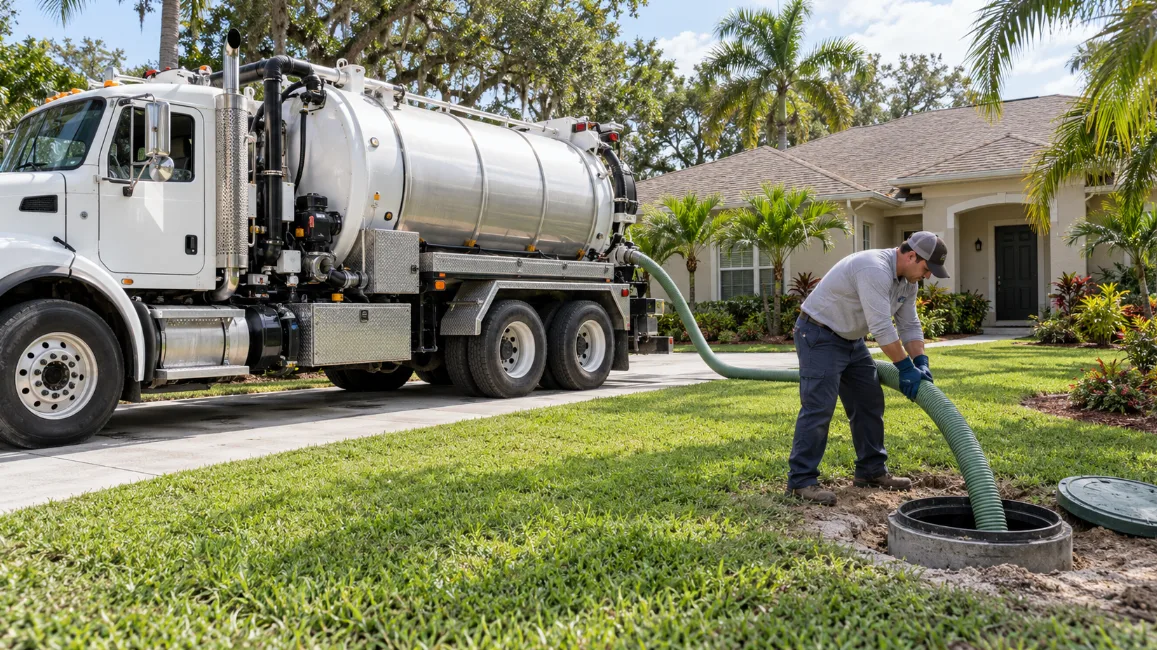
Septic tank pumping removes accumulated solids and wastewater from the tank. In Deltona, a backup can also involve an outlet restriction, pump fault or wet drain field, so the pump-out needs to fit the actual cause.
Explore Septic ServiceSeptic tank cleaning goes beyond bulk waste removal when grease deposits, filters or remaining residue need attention. We define the cleaning method around the condition of the tank and its components.
Explore Septic ServiceA septic tank inspection examines the tank and accessible equipment, with the findings compared against the system record and current property use. It is distinct from a government construction inspection or permit approval.
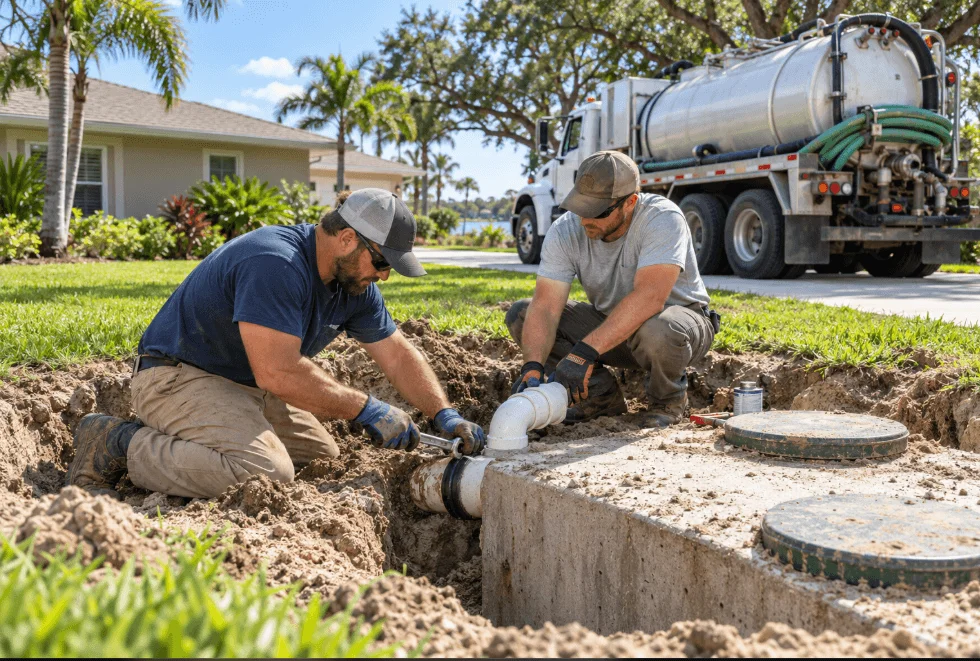
Explore Septic ServiceSeptic tank repair starts with a specific fault: a leaking riser, damaged cover, broken fitting, restricted outlet or failed dosing component. Structural tank damage and a failing drain field need different recommendations.
Explore Septic ServiceNew installation and replacement require an approved combination of tank storage, treatment equipment and a usable drain field. Deltona projects also need sewer, groundwater and parcel-level nutrient-reduction checks before equipment is selected.
Explore Septic ServiceAn urgent septic backup needs a safe assessment and a clear next step. Pumping can help when accumulated waste or high tank contents are involved, while flooded soil, outlet faults and equipment failure may require additional action.
Explore Septic Service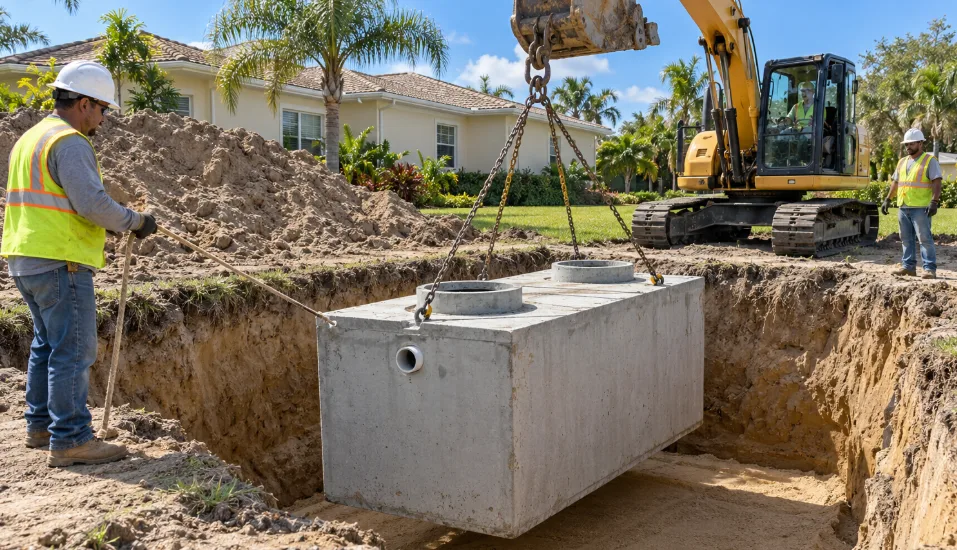
A tank can be sound while the field struggles. Review distribution, soil and groundwater before deciding on repair or replacement.
Drain field repair distinguishes damage to a pipe, connection or distribution component from soil that cannot receive the flow. Deltona’s wet-ground and lake conditions belong in that diagnosis.
Explore Drain Field ServiceA drain field inspection follows wastewater beyond the tank. It helps explain recurring symptoms by considering distribution, accessible dosing equipment, site changes and the condition of the receiving area.
Explore Drain Field ServiceDrain field replacement plans a suitable receiving area when the existing field cannot be restored reliably. The scope must distinguish a field-only project from tank, treatment or full-system replacement.
Explore Drain Field ServiceConnect the house plan, the installed system and the actual parcel before choosing a tank or a replacement field.
The September 2026 Realtor.com series published by FRED reports a 1,585-square-foot median for Volusia County home listings. This county listing benchmark is not an average of all Deltona homes or a survey of septic-served houses. A three-bedroom, two-bath home around 1,600 square feet is a useful planning example, not a measured citywide bedroom or bathroom average. Current county table · Series and methodology.
Florida uses both bedrooms and building area. When the two categories differ, the calculation producing the greater design flow controls. A matched three-bedroom home of 1,201–2,250 square feet uses 300 gallons per day of design sewage flow and 900 gallons of minimum effective tank storage. A larger house can need more capacity even with the same bedroom count.
| Dwelling example | Design sewage flow | Minimum effective tank storage |
|---|---|---|
| 2 bedrooms, 751–1,200 sq ft | 200 gallons/day | 900 gallons |
| 3 bedrooms, 1,201–2,250 sq ft | 300 gallons/day | 900 gallons |
| 4 bedrooms, 2,251–3,300 sq ft | 400 gallons/day | 1,050 gallons |
| Approved residential flow of 401–500 gallons/day | 401–500 gallons/day | 1,200 gallons |
These are design examples, not a measured inventory of Deltona tanks. Installed systems can be larger, and older approved tanks may differ. Liquid storage, treatment-unit capacity and drain field area are separate calculations. Confirm the permit record, label, compartments and proposed use. Florida sizing rule · Tables I and II.
The Florida Department of Health in Volusia County remains the local septic permitting and inspection contact under DEP’s onsite sewage program. Deltona’s building and utility approvals are separate. Use the proper septic application for new construction, repair, an existing-system review or abandonment; a pumping visit is not construction approval. DOH-Volusia program · DEP county application instructions.
Use current forms and have DOH-Volusia confirm the repair package and fee for your scope. Historic packets can contain old rule references and old charges. Current DEP forms · Volusia’s published fee-increase chart · Environmental Health permit portal. Government fees are separate from contractor service prices.
Allow 4–6 business days for initial processing of a complete, paid application as a planning allowance. This is the website’s scheduling allowance, not a published DOH-Volusia turnaround or an approval guarantee. No current county-wide queue duration was established in the reviewed sources. Missing information, workload, field evaluation, engineering, advanced treatment or parallel city approvals can extend the schedule.
| Stage or route | Time reference | What it means |
|---|---|---|
| Initial processing allowance | 4–6 business days after a complete submission and payment | A planning allowance; confirm the current county queue |
| Ordinary administrative review | Generally 30 days to identify application deficiencies; 90 days to approve or deny a complete application unless a shorter law applies | Section 120.60 framework, not the typical installation schedule; legal exceptions and proceedings can affect the clock |
| Qualifying engineer-designed performance-based route | 5 working days for an incompleteness request; 15 working days after a complete application for permit issuance or noncompliance notice and referral | The special section 381.0065 route; not every system with a drawing or an aerator qualifies |
| Repair permit | Rule 62-6.015 directs every effort to issue within two working days | An effort target, not guaranteed approval, dispatch or repair completion |
| Construction and final inspection | Schedule separately after the required authorization | Installer availability, weather, inspection readiness and corrections affect completion |
Keep site evaluation, design, permit review and construction as separate items in the proposal. Ask which application type has been submitted, whether it is complete and what remains outstanding. Section 120.60 · Section 381.0065 · Repair-permit rule.
DEP lists the Volusia Blue Spring BMAP as effective June 27, 2025. BMAP means Basin Management Action Plan; its Priority Focus Area is a more specific mapped area. For qualifying new systems on lots of one acre or less within the affected BMAP, sewer availability and nitrogen-reducing treatment requirements must be checked before selecting a conventional design.
The adopted plan also addresses existing systems on lots of one acre or less within the Priority Focus Area. When construction permitting is needed to repair, modify or replace a covered system, the plan calls for approved treatment achieving at least 65% nitrogen reduction, subject to its documented planned-and-funded sewer-connection exception. Confirm the parcel, permit category and current implementation with DOH-Volusia. Routine pumping is different from permitted construction. These rules are not a blanket requirement for every Deltona tank or every maintenance visit. Adopted plan and final order · Address-searchable DEP requirements map · DEP treatment guidance.
Deltona’s residential new-construction checklist calls for a septic permit, soil-analysis sheet and survey showing the system location, or proof of sanitary sewer. The City’s occupancy checklist also calls for the septic final or sewer clearance. Coordinate the site survey, drainage, relevant flood-zone documents and the required inspection stages rather than treating an issued septic permit as permission to occupy the house. City new-construction checklist · Certificate-of-occupancy checklist.
Closed-basin drainage: the City identifies the Theresa Basin as a hydrologically closed watershed where interconnected lakes recover mainly through groundwater recharge and evapotranspiration. Extended high lake levels and saturated soil can limit field performance even after visible stormwater has gone. The septic implication is to assess groundwater and the receiving soil, not assume another pump-out will dry the field. City Theresa Basin study.
Layout and altered use: pools, paving, additions, converted rooms and changes to commercial occupancy can reduce usable treatment area or change wastewater demand. Compare current use and the survey with the approved system before enlarging or replacing components.
Flooded ground: reduce avoidable water use, avoid contact with sewage and have the system assessed before pumping or driving heavy equipment over saturated soil. Emptying a tank in high groundwater can risk movement or flotation. EPA flooded-system guidance.
What looks like a tank failure can start in the drain field, the plumbing or the way the property uses water.
Overdue pumping lets sludge and floating waste build up. Escaped solids can clog the field.
Running toilets, leaks and back-to-back laundry loads can overwhelm the system’s capacity.
Grease and wipes obstruct flow. Harsh chemicals can disrupt treatment and harm the system.
Saturated ground leaves too little space for wastewater to drain and receive soil treatment.
Roots can enter openings. Vehicles crush components or compact soil. Broken fittings also disrupt flow.
Deteriorated or undersized systems struggle. On advanced systems, missed pump and aerator care can interrupt treatment.
A septic system is more than a tank. Its storage capacity, treatment process and drain field each do a different job. Use this guide to understand home size, tank materials, expected lifespan and Deltona conditions before choosing a service.
Volusia County’s listed-home median was 1,585 square feet in September 2026. A three-bedroom, two-bath home near 1,600 square feet is a useful example for discussing service, but it does not establish the city’s average floor plan. House additions, enclosed spaces and changed use should be compared with the existing septic approval. Housing source.
Bathrooms affect household use, but counting fixtures alone does not select a Florida residential tank. Bedrooms and building area establish a design-flow starting point; tank storage, treatment equipment and the field each need appropriate capacity.
Residential storage examples include 900, 1,050 and 1,200 gallons. A matched three-bedroom home of 1,201–2,250 square feet has a 300-gallon-per-day design-flow example and 900 gallons of minimum effective tank storage. This is a state sizing example, not a claim that every Deltona home has a 900-gallon tank.
| Dwelling example | Design sewage flow | Minimum effective tank storage |
|---|---|---|
| 2 bedrooms, 751–1,200 sq ft | 200 gallons/day | 900 gallons |
| 3 bedrooms, 1,201–2,250 sq ft | 300 gallons/day | 900 gallons |
| 4 bedrooms, 2,251–3,300 sq ft | 400 gallons/day | 1,050 gallons |
| Approved residential flow of 401–500 gallons/day | 401–500 gallons/day | 1,200 gallons |
When the bedroom and building-area categories disagree, the more demanding flow calculation controls. Additional treatment compartments or equipment may be needed. Commercial flow is based on the establishment and activity rather than a residential bedroom table. System-size rule · Florida sizing tables.
For pumping, use the installed label and approval record to identify actual capacity and compartments. For installation, use the approved site design. A larger tank cannot compensate for unsuitable soil, inadequate treatment or an overloaded field.
A heavy shell requiring suitable lifting access and base preparation. Inspect covers, walls, seams and fittings. Weight does not make an emptied tank immune to groundwater uplift.
A lighter composite shell. Handling, connections, support and backfill need to match the approved model and site. Inspect for impact damage and leakage.
A molded plastic shell that can help with restricted access. Correct burial, backfill and groundwater provisions matter; light weight alone does not establish suitability.
Expected service life depends on the installed product, site conditions and maintenance. The tank shell, drain field, pump and control equipment age differently. Assess condition and performance before deciding to replace equipment; age alone is not a diagnosis. EPA material and lifespan questions.
A conventional tank separates solids before effluent reaches a suitable soil-treatment area. Aerobic equipment uses oxygen as part of treatment, while a performance-based system is designed around specified effluent criteria. Tank material is separate from treatment type.
Not every aerator meets a nitrogen-reduction requirement. Where enhanced treatment is required, select approved equipment and understand its operating permit, maintenance agreement and inspection obligations. The permit category also affects the review route. DEP approved treatment guidance.
For Deltona parcels, check the active Volusia Blue Spring BMAP, Priority Focus Area boundaries, lot size, sewer availability and whether the job is new construction, regulated repair or routine maintenance. The local permitting section explains the distinction and the current-source links.
The Theresa Basin’s closed drainage pattern can allow high lake and groundwater levels to persist. A field that cannot accept flow needs a receiving-soil and distribution assessment. Pumping removes tank contents; it does not lower the surrounding water table. City drainage study · UF/IFAS soil-treatment guidance.
A restricted filter, failed pump, leaking riser or broken pipe can create symptoms resembling a failed field. Review accessible equipment, wastewater use, site changes and permit records before choosing between maintenance, component repair and replacement.
A pool, widened driveway, heavy-vehicle route or addition can interfere with the field and future access. Preserve the approved treatment area, and have the layout reviewed before covering or excavating around system components.
When ground is flooded, limit wastewater loading and keep people away from sewage. Have pumping conditions assessed professionally, and avoid compacting wet treatment soil with heavy equipment. EPA flood guidance.
Start with the parcel, sewer status and project classification. Prepare the signed application, site and floor plans, qualified evaluation, applicable design and fees. The 4–6-business-day initial planning allowance does not include every evaluation, design, construction and inspection stage. Check DOH-Volusia’s current queue before scheduling work.
Deltona’s building approval and septic final are separate checkpoints. A privately arranged condition inspection or real estate report is also different from a government construction inspection. Keep the required authorizations and inspection responsibilities in the work proposal. Complete local permit, timing and document guide.
Practical answers for Deltona homes and businesses.
Florida’s matched three-bedroom, 1,201–2,250-square-foot example uses 300 gallons per day of design flow and 900 gallons of minimum effective tank storage. The greater bedroom or building-area demand controls, and the approved treatment design and installed records determine the actual system.
Volusia County’s median listed-home size was 1,585 square feet in September 2026. That is a county listing benchmark, not an average of all Deltona homes or septic-served properties. A three-bedroom home around 1,600 square feet is an illustrative example.
Use 4–6 business days as an initial processing planning allowance after a complete, paid application, then confirm DOH-Volusia’s current queue. It is not an official turnaround guarantee. Site evaluation, design, missing information, engineering, other approvals and construction can add time.
No blanket citywide assumption is appropriate. The parcel’s mapped area, lot size, sewer availability and permit category determine requirements. Covered new systems and certain permitted repairs or replacements can require approved nitrogen-reducing treatment.
Lake levels and groundwater can remain elevated in closed-basin areas such as the Theresa Basin. Tank or distribution faults are also possible. Pumping does not lower the surrounding groundwater.
Set the interval around measured solids, actual capacity, occupancy and water use. Many conventional household systems need pumping about every three to five years; advanced equipment has additional care requirements.
Yes. Describe the property, business use if applicable, waste type and access. Commercial design flow and equipment cannot be selected from a residential bedroom example.
No. Availability, dispatch and arrival timing must be confirmed separately. Limit avoidable wastewater use and keep people away from sewage while obtaining prompt professional assistance.
Tell us where you are, what is happening and the service you need.